




Texas Instruments LM5166EVM-C50A Evaluation Module (EVM)
Texas Instruments LM5166EVM-C50A Evaluation Module (EVM) is designed to showcase the performance and all features of the LM5166. The LM5166 is a wide-VIN, synchronous buck converter with an ultra-low no-load supply current. The design is packaged in a tiny footprint with a low component count. It operates over a wide input voltage range of 6V to 65V to deliver a fixed 5V output with better than 2% setpoint accuracy. Low dropout performance whenever the input voltage decreases below the output voltage setpoint is available with 100% duty cycle conduction of the high-side MOSFET. Under the Texas Instruments LM5166's constant-on-time (COT) control scheme and diode emulation, the no-load supply current is only 14μA at a 24V input.
Features
- 6V to 65V input voltage range
- Ultra-high power conversion efficiency: > 90% at an output of 5V and above 1mA load (input voltage 12V)
- 5V target output voltage
- COT or PFM control architecture
- No-load supply current as low as 12µA
Required Equipment
- Voltage Source
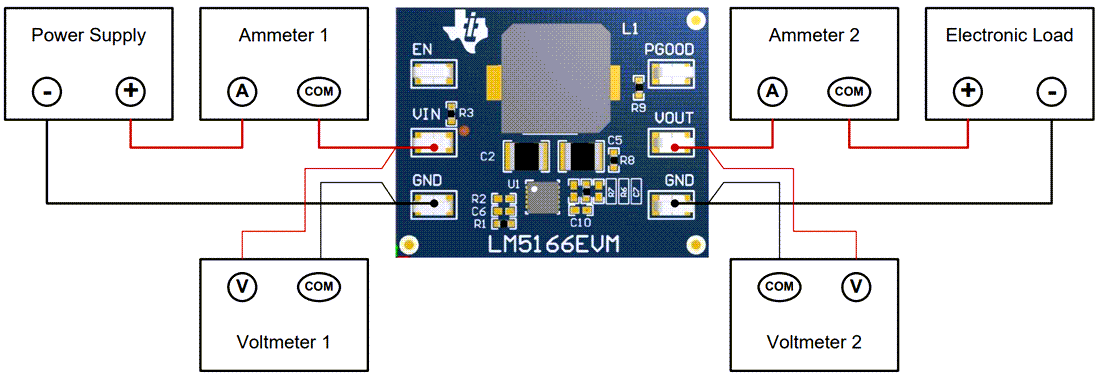
- The input voltage source VIN should be a 0–70V variable DC source capable of supplying 1A
- Multimeters
- Voltmeter 1
- Input voltage at VIN to GND
- Set the voltmeter to input impedance of 1GΩ
- Voltmeter 2
- Output voltage at VOUT to GND
- Set the voltmeter to input impedance of 1GΩ
- Ammeter 1
- Input current
- Set ammeter to 1-second aperture time
- Ammeter 2
- Output current
- Set ammeter to 1-second aperture time
- Voltmeter 1
- Electronic Load
- The load should be an electronic constant-resistance (CR) or constant-current (CC) mode load capable of 0mADC to 750mADC at 5V
- For a no-load input current measurement, disconnect the electronic load as it may draw a small residual current
- Oscilloscope
- With the scope set to 20MHz bandwidth and AC coupling, measure the output voltage ripple directly across an output capacitor with a short ground lead normally provided with the scope probe
- Place the oscilloscope probe tip on the positive terminal of the output capacitor, holding the probe's ground barrel through the ground lead to the capacitor's negative terminal
- It is not recommended to use a long-leaded ground connection because this may induce additional noise given a large ground loop
- To measure other waveforms, adjust the oscilloscope as needed
Test Setup
Related Product
Texas Instruments LM5166 Synchronous Buck Converter
Compact, easy-to-use with high efficiency over wide input voltage and load current ranges.
Published: 2017-02-07
| Updated: 2022-03-23