




Texas Instruments UCC27710 620V Gate Drivers With Interlock
Texas Instruments UCC27710 620V Gate Drivers With Interlock are designed to drive power MOSFETs or IGBTs, with both a High-Side and Low-Side 0.5A source gate driver. The UCC27710 is developed with TI's state-of-the-art high-voltage technology offering robust drive and exceptional noise and transient immunity. VDD recommended operating voltage for IGBTs is 10V to 20V and 10V to 17V for power MOSFETs. An excellent protection feature includes interlock and deadtime functions, which prevents both outputs from being turned on simultaneously. Additionally, the outputs are held low when the inputs are left open or when the minimum input pulse width specification is not met. The device also provides UVLO protection for the VDD and HB bias supply with an accepted wide-range bias supply range from 10V to 20V. The Texas Instruments UCC27710 includes one ground-referenced channel (LO) and one floating channel (HO), designed for operating with bootstrap or isolated power supplies.
Features
- High-side and low-side configuration
- Dual inputs with output interlock and 150ns deadtime
- Fully operational up to 620V, 700V absolute maximum on HB pin
- 10V to 20V VDD recommended range
- Peak output current 0.5A source, 1.0A sink
- dv/dt immunity of 50V/ns
- Logic operational up to –11V on HS pin
- Negative voltage tolerance on inputs of –5V
- A large negative transient safe operating area
- UVLO protection for both channels
- Small propagation delay (140ns typical)
- Delay matching (8ns typical)
- Floating channel designed for bootstrap operation
- Low quiescent current
- TTL and CMOS-compatible inputs
- Industry-standard SOIC-8 package
- All parameters specified over a temperature range of –40°C to +125°C
Applications
- Motor drive (stepper motors, HVAC, fans, power tools, robotics, drones, servos)
- Lighting, LED power supply, indoor lighting
- Appliances, washer and dryer, refrigerator
- Induction heating
- DC-to-AC inverters
Development Tool
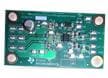
Texas Instruments UCC27710EVM-005 Driver Evaluation Module (EVM)
Designed for evaluation of the UCC27710D, a 620V half-bridge gate driver.
Published: 2018-04-11
| Updated: 2025-07-03