



Texas Instruments TFP410 PanelBus™ Digital Transmitter
Texas Instruments TFP410 PanelBus™ Digital Transmitter is a PanelBus™ flat-panel display product of end-to-end DVI 1.0-compliant solutions targeted at the consumer electronics and PC industry. The TFP410 device provides a universal interface, allowing glueless connection to the most commonly available graphics controllers. Some advantages of this universal interface include selectable bus widths, adjustable signal levels, and single-ended and differential clocking. The adjustable 1.1V to 1.8V digital interface provides a high-speed, low-EMI bus that connects with 24-bit or 12-bit interfaces. The DVI interface supports flat-panel display resolutions up to UXGA at 165MHz in 24-bit true color pixel format.
The TFP410 device combines PanelBus circuit innovation with Texas Instruments ultra-low ground inductance PowerPAD package and advanced 0.18µm EPIC-5 CMOS process technology. The result is a compact 64-pin TQFP package providing a reliable, low-noise, low-current, high-speed digital interface solution.
Features
- Digital Visual Interface (DVI) compliant
- Supports pixel rates up to 165MHz (including 1080p and WUXGA at 60Hz)
- Universal graphics controller interface
- 12-bit, dual-edge and 24-bit, single-edge input modes
- Adjustable 1.1V to 1.8V and standard 3.3V CMOS input
- Signal levels
- Fully differential and single-ended input clocking modes
- Standard Intel 12-bit digital video port compatible as on Intel™ 81x Chipsets
- Enhanced PLL noise immunity
- On-chip regulators and bypass capacitors to reduce system costs
- Enhanced jitter performance
- No HSYNC jitter anomaly
- Negligible data-dependent jitter
- Programmable using I2C serial interface
- Monitor detection through hot-plug and receiver detection
- Single 3.3V supply operation
- 64-pin TQFP using TI’s PowerPAD™ package
- TI’s advanced 0.18µm EPIC-5™ CMOS process technology
- Pin compatible with SiI164 DVI transmitter
Applications
- DVD
- Blu-ray
- HD projectors
- DVI/HDMI transmitter (HDMI video-only)
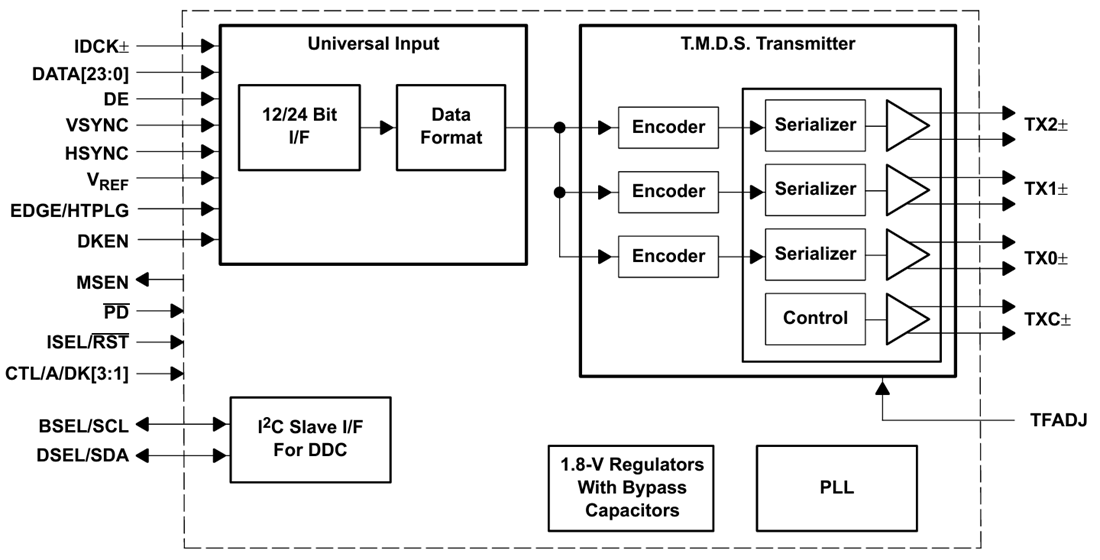
Functional Block Diagram
Published: 2024-01-03
| Updated: 2024-01-15