




NXP Semiconductors LPC82x 32-bit Arm® Cortex®-M0+ MCUs
NXP Semiconductors LPC82x 32-bit Arm® Cortex®-M0+ MCUs are designed for higher integration over the LPC81x, with a larger memory footprint that doubles maximum flash and SRAM size. The LPC82x offers three select peripherals to ease the transition into the 32-bit space. Furthermore, the switch matrix allows users the flexibility to map pins accordingly to simplify component routing on a PCB.
The NXP LPC82x MCUs feature a SCTimer, which can be configured to generate a variety of timing or PWM waveforms without the intervention of the CPU. To simplify serial communication requirements, the pattern match engine can be configured to generate interrupts from user-configurable Boolean operations on its eight pins. The LPC800 series shares critical pinouts through the range of subfamilies and packages, and customers can easily swap or scale packages and subfamilies as required.
Features
- System:
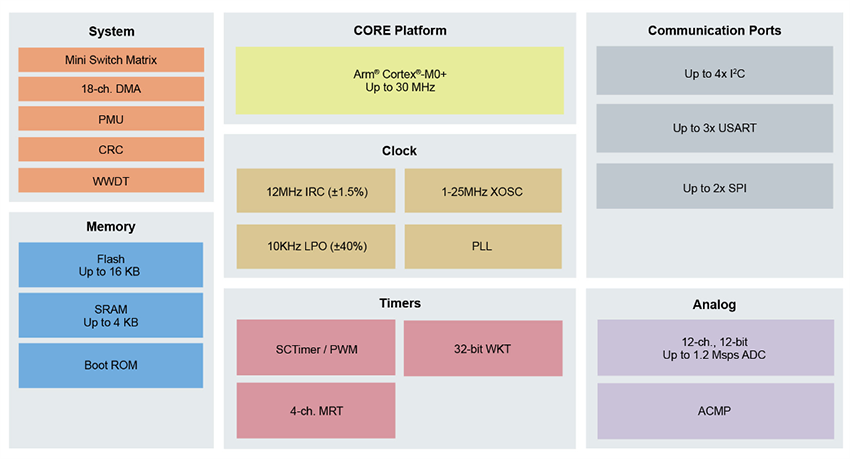
- ARM Cortex-M0+ processor (revision r0p1), running at frequencies of up to 30MHz with single-cycle multiplier and fast single-cycle I/O port
- ARM Cortex-M0+ built-in Nested Vectored Interrupt Controller (NVIC)
- System tick timer
- AHB multilayer matrix
- Serial Wire Debug (SWD) with 4x break points and 2x watchpoints, JTAG boundary scan (BSDL) supported
- MTB
- Memory:
- Up to 32KB on-chip flash programming memory with 64 Byte page write and erase, Code Read Protection (CRP) supported
- 8KB SRAM
- ROM API support:
- Boot loader
- On-chip ROM APIs for ADC, SPI, I2C, USART, power configuration (power profiles), and integer divide
- Flash In-Application Programming (IAP) and In-System Programming (ISP)
- Digital peripherals:
- High-speed GPIO interface connected to the ARM Cortex-M0+ IO bus with up to 29x General-Purpose I/O (GPIO) pins with configurable pull-up/pull-down resistors, programmable open-drain mode, input inverter, and digital filter, GPIO direction control supports independent set/clear/toggle of individual bits
- High-current source output driver (20mA) on 4x pins
- High-current sink driver (20mA) on 2x true open-drain pins
- GPIO interrupt generation capability with a boolean pattern-matching feature on 8x GPIO inputs
- Switch matrix for flexible configuration of each I/O pin function
- CRC engine
- DMA with 18x channels and 9x trigger inputs
- Timers:
- State Configurable Timer (SCTimer/PWM) with input and output functions (including capture and match) for timing and PWM applications, each SCTimer/PWM input is multiplexed to allow selecting from several input sources such as pins, ADC interrupt, or comparator output
- 4-channel Multi-Rate Timer (MRT) for repetitive interrupt generation at up to 4x programmable, fixed rates
- Self-Wake-up Timer (WKT) clocked from either the IRC, a low-power, low-frequency internal oscillator, or an external clock input in the always-on power domain
- Windowed Watchdog timer (WWDT)
- Analog peripherals:
- 1x12-bit ADC with up to 12x input channels with multiple internal and external trigger inputs and with sample rates of up to 1.2Msamples/s, the ADC supports two independent conversion sequences
- Comparator with 4x input pins and external or internal reference voltage
- Serial peripherals:
- 3x USART interfaces with pin functions assigned through the switch matrix and one common fractional baud rate generator
- 2x SPI controllers with pin functions assigned through the switch matrix
- 4x I2C-bus interfaces, 1x I2C supports fast-mode plus with 1Mbit/s data rates on 2x true open-drain pins and listen mode, 3x I2Cs support data rates up to 400kbit/s on standard digital pins
- Clock generation:
- 12MHz internal RC oscillator trimmed to 1.5% accuracy that can optionally be used as a system clock
- Crystal oscillator with an operating range of 1MHz to 25MHz
- Programmable watchdog oscillator with a frequency range of 9.4kHz to 2.3MHz
- PLL allows CPU operation up to the maximum CPU rate without the need for a high-frequency crystal, may be run from the system oscillator, the external clock input, or the internal RC oscillator
- Clock output function with divider that can reflect all internal clock sources
- Power control:
- Power consumption in active mode as low as 90µA/MHz in low-current mode using the IRC as the clock source
- Integrated PMU (Power Management Unit) to minimize power consumption
- Reduced power modes: Sleep mode, Deep-sleep mode, Power-down mode, and Deep power-down mode
- Wake-up from Deep-sleep and Power-down modes on activity on USART, SPI, and I2C peripherals
- Timer-controlled self-wake-up from Deep power-down mode
- Power-On Reset (POR)
- Brownout detection (BOD)
- Unique device serial number for identification
- Single power supply (1.8V to 3.6V)
- Operating temperature range from -40°C to +105°C
- Available in a TSSOP20 and HVQFN33 (5x5) package
Applications
- Automotive
- Heating Ventilation and Air Conditioning (HVAC)
- Industrial
- 3-Phase AC induction motor
- Air Conditioning (AC)
- Brushless DC Motor (BLDC) control
- Heat metering
- Industrial HMI
- Motion control and robotics
- Permanent Magnet Synchronous Motor (PMSM)
- Smart power socket and light switch
- Mobile
- Hearables
- Wristband
- Smart city
- Automatic vehicle identification
- Transport ticketing
- Smart home
- Home security and surveillance
- Major home appliances
- Small and medium appliances
Block Diagram
Associated Development Platforms
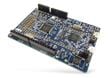
NXP Semiconductors LPCXpresso Development Platform
Development tools featuring NXP LPC Arm® Cortex® MCUs, designed for simplicity and ease of use.
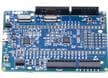
NXP Semiconductors LPCXpresso824-MAX Development Board for LPC820 MCU
Enables the evaluation and prototyping of the LPC82x 32-bit Arm® Cortex®-M0+ family of MCUs.
Associated Products
NXP Semiconductors LPC800 Series MCUs
Offer exceptional ease of use, design flexibility, efficiency, and advanced integration.
NXP Semiconductors LPC84x 32-bit Arm® Cortex®-M0+ MCUs
Low-power, 30MHz Arm® Cortex®-M0+ core based Microcontroller with advanced power optimization.
NXP Semiconductors LPC80x 32-bit Arm® Cortex®-M0+ MCUs
Cost-effective Arm® Cortex®-M0+ based 32-bit MCU ideal for entry-level IoT applications