


Espressif Systems ESP32-C61 Wi-Fi® 6 + BLUETOOTH® 5 (LE) SoCs

Espressif Systems ESP32-C61 Wi-Fi® 6 + BLUETOOTH® 5 (LE) System-on-Chip (SoC) features optimized peripherals, improved connectivity, and increased memory options. The Wi-Fi 6 is designed for IoT devices, while the SoC supports a 20MHz bandwidth for 802.11ax mode and a 20MHz/40MHz bandwidth for 802.11b/g/n mode. The 802.11ax mode supports characteristics like OFDMA and MU-MIMO, which supply reliable and low-latency connections, and Target-Wake-Time, the basis of ultra-low power applications. Additionally, Bluetooth 5 (LE) radio facilitates long-range operation through advertisement extension and coded PHY while supporting 2Mbps of high throughput PHY. The ESP32-C61 will also benefit from the BLE-Mesh 1.1 protocol.
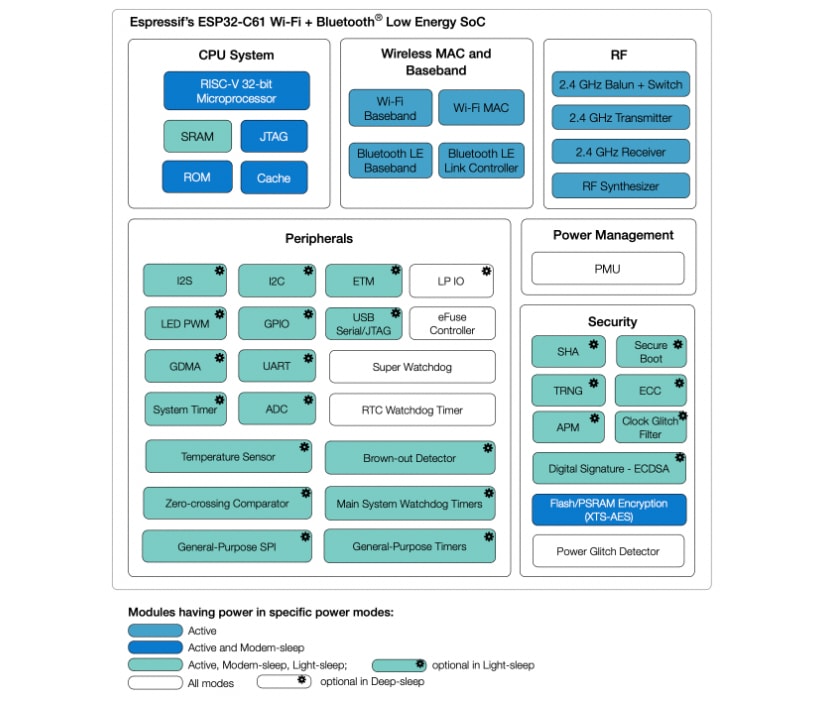
The ESP32-C61 chip incorporates a robust set of peripherals, including SPI, I2C, UART, I2S, ADC, GDMA, ETM, and an analog comparator, making it excellent for a wide range of applications, from smart home devices to other varied connected applications.
A key advantage of ESP32-C61 is its external PSRAM support, which allows developers to build feature-rich applications without being constrained by internal memory limits. The external PSRAM delivers higher software development flexibility, permitting more room for larger data buffers, additional functionality, and future upgrades with less time spent on memory optimization.
The Espressif Systems ESP32-C61 fully aids the ESP-IDF and the ESP-Matter SDK. The device can operate as a wireless co-processor through ESP-AT or ESP-Hosted, facilitating seamless integration into a variety of system architectures.
Features
- Ultra-low-power MCU with 32-bit RISC-V single-core microprocessor
- 2.4GHz Wi-Fi 6 (802.11ax), Bluetooth 5 (LE)
- 3.3V flash or PSRAM in the chip’s package
- 25 GPIOs
- Security features of secure boot, flash and PSRAM encryption, cryptographic accelerators, Trusted Execution Environment (TEE), and ECDSA-based Digital Signature Peripheral
Applications
- Smart home
- Industrial automation
- Healthcare
- Consumer electronics
- Smart agriculture
- Point-of-sale (POS) machines
- Service robots
- Audio devices
- Generic low-power IoT
- Sensor hubs
- Data loggers
Associated SoCs
Espressif Systems ESP32-C6 Ultra-Low-Power System-on-Chips (SoCs)
Support Wi-Fi 6 in the 2.4GHz band, BLUETOOTH® 5, Zigbee® 3.0, and Thread 1.3.
Development Tools
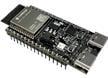
Espressif Systems ESP32-C61-DevKitC-1 Development Kit
Features the ESP32-C61-WROOM-1 general-purpose module with up to 8MB SPI flash and 2MB PSRAM.
Block Diagram