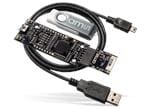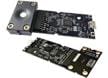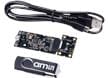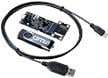

TMD3725-EVM

ams OSRAM
985-TMD3725-EVM
TMD3725-EVM

Mfr.:

Description:
Optical Sensor Development Tools ALS/COLOR/PROX

Availability

Stock:
Non-Stocked
Factory Lead Time:
2 Weeks Estimated factory production time.
Minimum: 1   Multiples: 1
Unit Price:
-,-- €
Ext. Price:
-,-- €
Est. Tariff:
This Product Ships FREE

Pricing (EUR)

Qty. Unit Price
Ext. Price
211,30 € 211,30 €

Product Attribute Attribute Value Select Attribute
ams OSRAM
Product Category: Optical Sensor Development Tools
RoHS:  
Evaluation Modules
Color, Proximity Sensor
TMD3725
Brand: ams OSRAM
Interface Type: I2C
Product Type: Optical Sensor Development Tools
Series: TMD3725
Factory Pack Quantity: 1
Subcategory: Development Tools
Part # Aliases: 990600890 Q65114A3459
Unit Weight: 241,055 g
Products found:
To show similar products, select at least one checkbox
Select at least one checkbox above to show similar products in this category.
Attributes selected: 0

CNHTS:
8543709990
CAHTS:
8473302000
USHTS:
8473301180
MXHTS:
8473300401
ECCN:
EAR99

Mini TOPLED® LEDs

ams OSRAM Mini TOPLED® LEDs have been tailored to the demands of public and private passenger transport for high brightness and high quality. These LEDs combine pleasant white light with a much longer lifetime of up to 50,000 hours. OSRAM Mini TOPLED® LEDs are among the most economical on the market, consuming only 0.1W. From an operating current of 20mA, the Mini Topled achieves a typical luminous intensity of 1700mcd at a color temperature of 4000K, and 1900mcd at 6500K. Luminous intensity in candela corresponds to luminous flux in lumen emitted by a light source in a particular solid angle.

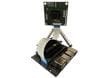
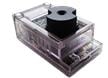
TMD3725 Eval Kit for TMD3725 Sensor Module

ams OSRAM TMD3725 Evaluation Kit has everything needed to evaluate the TMD3725 color sensor module. The kit includes a main controller board with a PIC microcontroller, and an industry-standard USB 2.0 interface (with a USB cable). Also included is a TMD3725 daughter card, "plug-n-play" USB HID class drivers, software documentation, and GUI software. The GUI allows for controlling proximity sensor settings as the PIC takes the I2C digital outputs to calculate proximity.