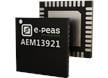


AEM15820-QFN40

e-peas
120-AEM15820-QFN40
AEM15820-QFN40

Mfr.:

Description:
Power Management Specialised - PMIC

Lifecycle:
New Product:
New from this manufacturer.
ECAD Model:
Download the free Library Loader to convert this file for your ECAD Tool. Learn more about the ECAD Model.

In Stock: 954

Stock:
954 Can Dispatch Immediately
Factory Lead Time:
7 Weeks Estimated factory production time for quantities greater than shown.
Minimum: 1   Multiples: 1
Unit Price:
-,-- €
Ext. Price:
-,-- €
Est. Tariff:

Pricing (EUR)

Qty. Unit Price
Ext. Price
6,97 € 6,97 €
5,37 € 53,70 €
4,97 € 124,25 €
4,53 € 453,00 €
4,51 € 1.127,50 €
3,83 € 3.830,00 €

Product Attribute Attribute Value Select Attribute
e-peas
Product Category: Power Management Specialised - PMIC
RoHS:  
Battery Management
SMD/SMT
QFN-40
100 mA
4.34 V
300 mV
3.3 V
- 40 C
+ 85 C
1 A
Application: Heaphone / Headsets, Laptops / E-readers, CCTV cameras, Toll badges, Robotics, Fleet management
Brand: e-peas
Development Kit: 2AAEM15820J001
Input Voltage Range: 300 mV to 4.34 V
Operating Supply Voltage: 300 mV to 4.34 V
Output Voltage Range: 600 mV to 3.3 V
Product: Power Management IC
Product Type: Power Management Specialized - PMIC
Factory Pack Quantity: 1000
Subcategory: PMIC - Power Management ICs
Products found:
To show similar products, select at least one checkbox
Select at least one checkbox above to show similar products in this category.
Attributes selected: 0

Compliance Codes
TARIC:
8542399000
USHTS:
8542390090
MXHTS:
8542399999
ECCN:
EAR99
Origin Classifications
Country of Origin:
China
Assembly Country of Origin:
Not available
Country of Diffusion:
Not available
The country is subject to change at the time of shipment.

AEM15820 Ultra Efficient Energy Manager PMIC

e-peas AEM15820 Ultra Efficient Energy Manager PMIC is a compact, fully integrated power management IC (PMIC) designed to harvest DC energy, store it in a rechargeable element, and supply power to an application circuit. The AEM15820 can also charge the storage element from a 5V input when additional energy is needed. The ultra‑efficient architecture helps extend battery life and, in many cases, remove the need for primary energy storage across a wide range of applications.