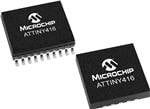

ATTINY416-MN

Microchip Technology
579-ATTINY416MN
ATTINY416-MN

Mfr.:

Description:
8-bit Microcontrollers - MCU 20MHz, 4KB, VQFN20, Ind 105C, Tray

Lifecycle:
New Product:
New from this manufacturer.
ECAD Model:
Download the free Library Loader to convert this file for your ECAD Tool. Learn more about the ECAD Model.

In Stock: 866

Stock:
866 Can Dispatch Immediately
Factory Lead Time:
6 Weeks Estimated factory production time for quantities greater than shown.
Minimum: 1   Multiples: 1
Unit Price:
-,-- €
Ext. Price:
-,-- €
Est. Tariff:

Pricing (EUR)

Qty. Unit Price
Ext. Price
0,645 € 0,65 €
0,593 € 14,83 €
0,537 € 53,70 €

Product Attribute Attribute Value Select Attribute
Microchip
Product Category: 8-bit Microcontrollers - MCU
AVR
4 kB
256 B
VQFN-20
20 MHz
10 bit
18 I/O
1.8 V
5.5 V
SMD/SMT
8 bit/16 bit
- 40 C
+ 105 C
Tray
Brand: Microchip Technology
DAC Resolution: 8 bit
Data RAM Type: SRAM
Data ROM Size: 128 B
Data ROM Type: EEPROM
Interface Type: I2C, SPI, UART
Number of ADC Channels: 12 Channel
Number of Timers/Counters: 1 x 12 bit, 3 x 16 bit
Operating Supply Voltage: 1.8 V to 5.5 V
Product: Microcontrollers
Product Type: 8-bit Microcontrollers - MCU
Program Memory Type: Flash
Factory Pack Quantity: 490
Subcategory: Microcontrollers - MCU
Watchdog Timers: Watchdog Timer
Products found:
To show similar products, select at least one checkbox
Select at least one checkbox above to show similar products in this category.
Attributes selected: 0

This functionality requires JavaScript to be enabled.

TARIC:
8542319000
CNHTS:
8542319092
CAHTS:
8542310000
USHTS:
8542310015
ECCN:
EAR99

ATtiny416 8-Bit Microcontrollers

Microchip Technologies ATtiny416 8-Bit Microcontrollers offer a high-performance, low-power AVR® RISC architecture with a maximum clock frequency up to 20MHz and a 4KB program memory size. These ATtiny416 8-bit MCUs also feature 256B of SRAM, 128B of EEPROM, and 4KB of in-system self-programmable flash memory. These MCUs use core independent peripherals and picoPower® technology to enable flexible and low power architecture. The MCUs include an event system, sleepwalking, accurate analog features, and advanced peripherals.